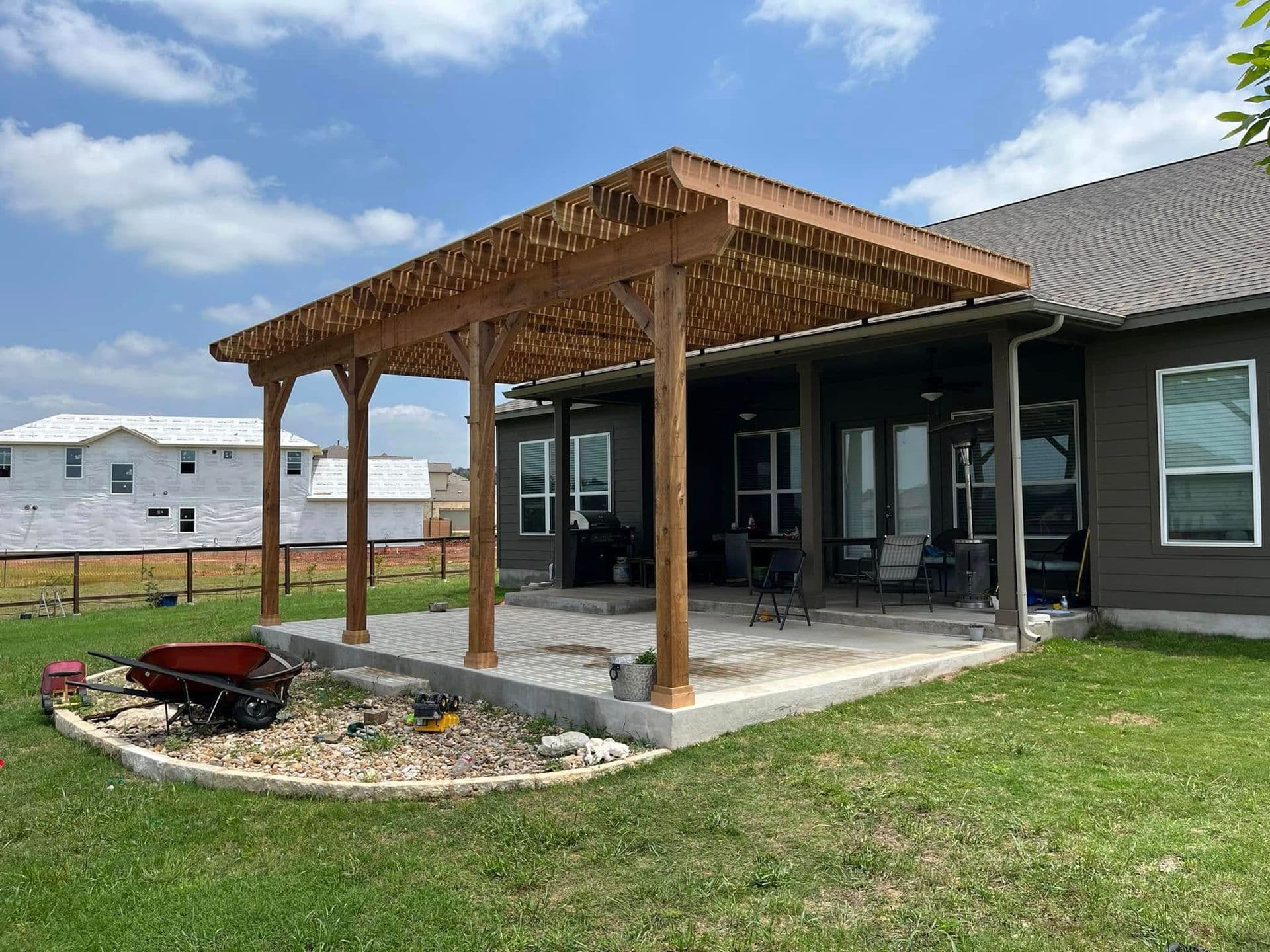
On a Lakeway lot, the best pergola frames the view instead of blocking it. That means keeping the beam line below your sight line from inside the house, running rafters toward the lake, and anchoring the posts into limestone on sloped ground where wind comes straight off the water.
Designing a pergola around a Lake Travis view
We start inside the house. From the living room and the kitchen, we mark where your eye lands on the water and keep the main beams below that line. Rafters that run toward the lake read as thin lines from indoors. Rafters that run across the view stack up visually and hide it. That choice also changes the shade pattern, so we balance the view against the afternoon sun on your specific lot.
Deeper, more widely spaced rafters give a cleaner look and still cut glare. If you want more shade later, a retractable canopy can bring coverage to 90 percent or more without a permanent roof.
Sloped Lakeway lots and raised decks
Many Lakeway backyards drop toward the lake, and the pergola often goes on a raised deck. Posts that carry a pergola should run to their own footings, not sit on the deck boards. On steep ground, the downhill posts can be much taller than the uphill ones, so we check each footing location separately.
Tall posts also need a clean look from below, since on a sloped lot you often see the pergola from the yard beneath it. We keep hardware tidy and bolt patterns consistent so the underside looks as finished as the top.
Wind and rock in Lakeway
Wind off the lake reaches a Lakeway pergola with nothing to slow it down. Most lots have limestone very close to the surface, which we drill so each post is anchored in rock. Steel post bases keep the wood off the concrete, and bracing keeps a tall frame square. Cedar is our usual pick here because it stays straighter than pine as it dries, which matters on a structure you look at every day.
Permits and pricing in Lakeway
Permits are issued by the City of Lakeway, and communities like Rough Hollow add their own architectural review. We handle both. A 12x14 cedar pergola runs $14,000 to $22,000 and a 14x20 runs $22,000 to $35,000. Tall posts on a slope, deck reinforcement, and lighting are priced in the fixed quote after we see the site.
Lake humidity and strong sun are hard on finishes, so we stain every face of the cedar, including the tops of rafters you will never see. Plan to renew the stain every two to three years. Pressure-treated pine at $30 to $45 per square foot works for a painted pergola, but cedar's natural color usually suits a view structure better.
We Know Lakeway Backyards
Lakeway lots are built on the limestone hills above Lake Travis, and many of them fall away steeply from the back of the house toward the water or a canyon. That means the deck is often the main way to use the yard at all, and its railing decides what you see from inside. We build hillside decks, covered patios, pergolas, gazebos and outdoor kitchens across Lakeway.
Permits, HOAs, soil and local building tips for Lakeway
"First thing I look at in Lakeway is the view. Which way does the lake sit, where does the sun set. You want the deck oriented to take advantage of that, and railings that don't block it. Hillside builds take more engineering and more pier work than a flat lot, and we price that in up front."
- Mark Toomey
Why Pergolas Matter Here
Pergolas define outdoor rooms without enclosing them. They're perfect for creating an outdoor dining area, framing a view, or adding vertical interest to a flat yard. The open design allows climbing plants like wisteria or bougainvillea to create natural beauty.
Architectural Impact
A well-designed pergola elevates your entire landscape. It frames views, creates vertical interest, and adds sophistication that flat patios can't match.
Flexible Shade Options
Start with an open pergola and add shade later - retractable canopies or shade sails. Your needs may change; a pergola adapts.
Perfect for Plants
Climbing vines like wisteria, jasmine, or bougainvillea thrive on pergola structures. Create a natural, living shade canopy that blooms seasonally.
Defines Outdoor Rooms
A pergola creates a "ceiling" for your outdoor space without walls. It signals where the living area is, organizing your backyard naturally.