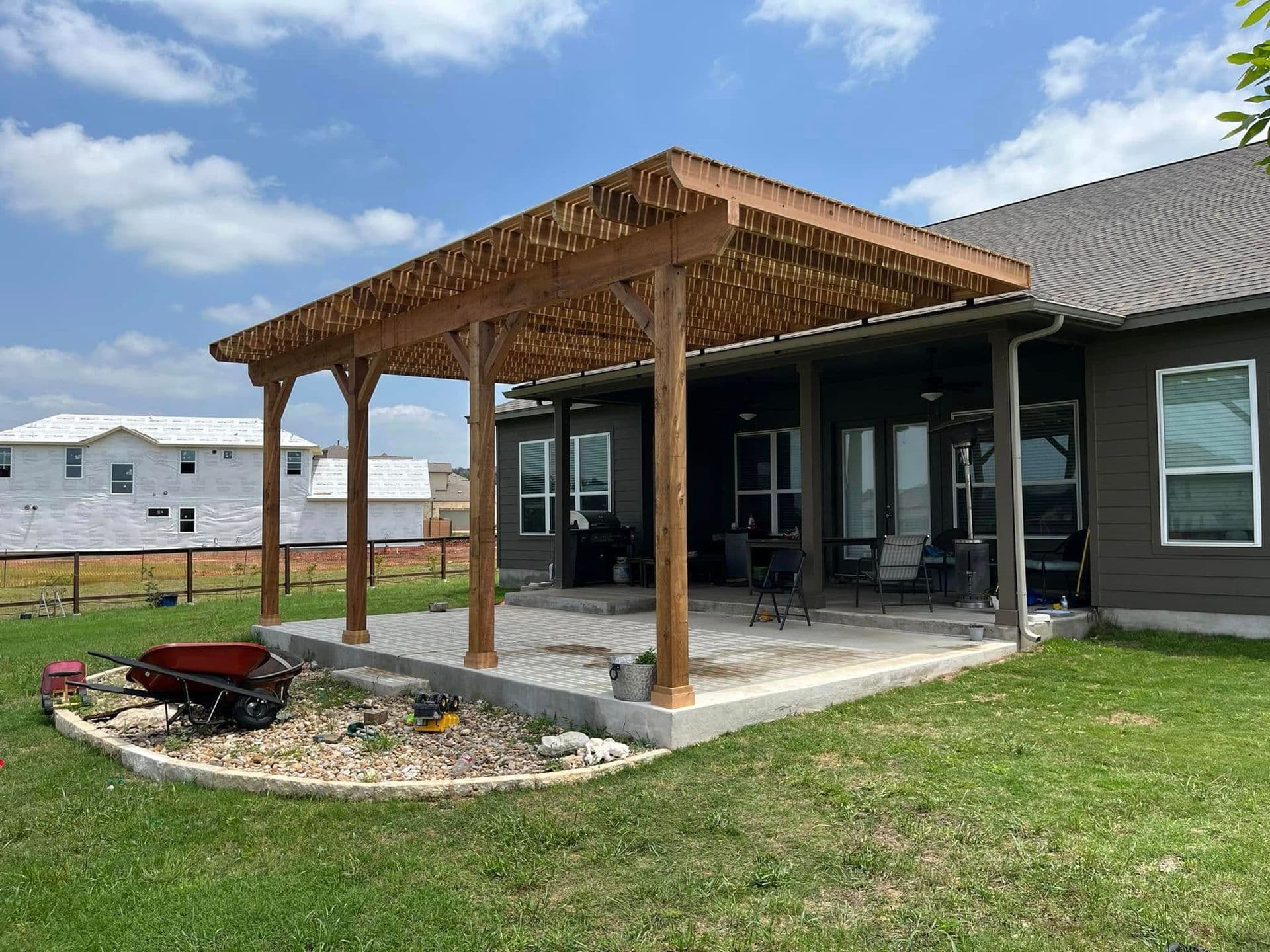
Inside Leander city limits a pergola needs a permit, because the City of Leander requires permits for arbors along with decks and patios. If your home is in Leander's ETJ, the city generally only permits signs and water or wastewater work, so your HOA becomes the main approval. All Seasons started in Leander in 1984, and this split is the first thing we check.
Leander city limits versus the ETJ
The City of Leander handles permits through its Development Hub and builds to the 2021 International Residential Code. Arbors, decks, patios, covers over existing slabs, and multi-level decks all need permits in the city. A pergola is reviewed as an arbor.
A large share of Leander addresses are in the extraterritorial jurisdiction, not the city. ETJ homes generally only need city permits for signs and water or wastewater. That does not mean anything goes. HOA architectural rules and deed restrictions still apply, and we still build to code.
Hilltop lots and wind on the frame
Parts of north and west Leander sit on high ground with long views and few mature trees. Wind hits a pergola there harder than it does in a sheltered yard. The open roof lets most of it through, so the risk is less about lifting and more about racking, where the frame leans a little more each storm. We size posts and beams for the span, add knee braces or moment connections where needed, and anchor posts to concrete with steel bases instead of burying wood.
High lots also take the full western sun with no trees to soften it. We set rafter depth and direction so the frame blocks the low afternoon light while leaving the view open, and we can add mounting points for a retractable canopy that brings shade to 90 percent or more.
Rock footings in Leander
Much of Leander has Hill Country limestone near the surface, with clay in lower areas. Rock gives a very firm footing once it is drilled. Clay pockets get deeper piers. We often know what is under a Leander street before the visit, but we still check each lot.
On a 12x14 cedar frame, the framing alone is 168 times $45 to $65, or about $7,600 to $10,900. Drilled footings, hardware, stain, and the permit make up the rest of the $14,000 to $22,000 project price.
Leander HOAs and pergola pricing
Communities like Crystal Falls, Travisso, and Bryson review outdoor structures before construction, often including stain color and height. We submit the HOA package first. Pricing stays the same across the area: $8,000 to $12,000 for an attached 10x12, $14,000 to $22,000 for a 12x14 cedar freestanding, and $22,000 to $35,000 for a 14x20 in cedar.
Pine is the lower cost option at $30 to $45 per square foot and suits a painted finish that matches trim.
We Know Leander Backyards
All Seasons started in Leander in 1984, when Peter Toomey founded the company here. Since then Leander has grown from a small town into a city of master-planned communities, most of them on rocky Hill Country ground and most with an HOA. We build decks, patio covers, pergolas, gazebos, screened porches and outdoor kitchens across Leander, and we handle the city permit and the HOA submission.
Permits, HOAs, soil and local building tips for Leander
"Dad started this company in Leander in 1984, and our shop is just up the road in Liberty Hill now. Most Leander homes are newer, so the question is usually how to attach to the house the right way. That means a flashed ledger bolted to the rim, not nailed to siding. Get that wrong and you've got water in the wall."
- Mark Toomey
Why Pergolas Matter Here
Pergolas define outdoor rooms without enclosing them. They're perfect for creating an outdoor dining area, framing a view, or adding vertical interest to a flat yard. The open design allows climbing plants like wisteria or bougainvillea to create natural beauty.
Architectural Impact
A well-designed pergola elevates your entire landscape. It frames views, creates vertical interest, and adds sophistication that flat patios can't match.
Flexible Shade Options
Start with an open pergola and add shade later - retractable canopies or shade sails. Your needs may change; a pergola adapts.
Perfect for Plants
Climbing vines like wisteria, jasmine, or bougainvillea thrive on pergola structures. Create a natural, living shade canopy that blooms seasonally.
Defines Outdoor Rooms
A pergola creates a "ceiling" for your outdoor space without walls. It signals where the living area is, organizing your backyard naturally.