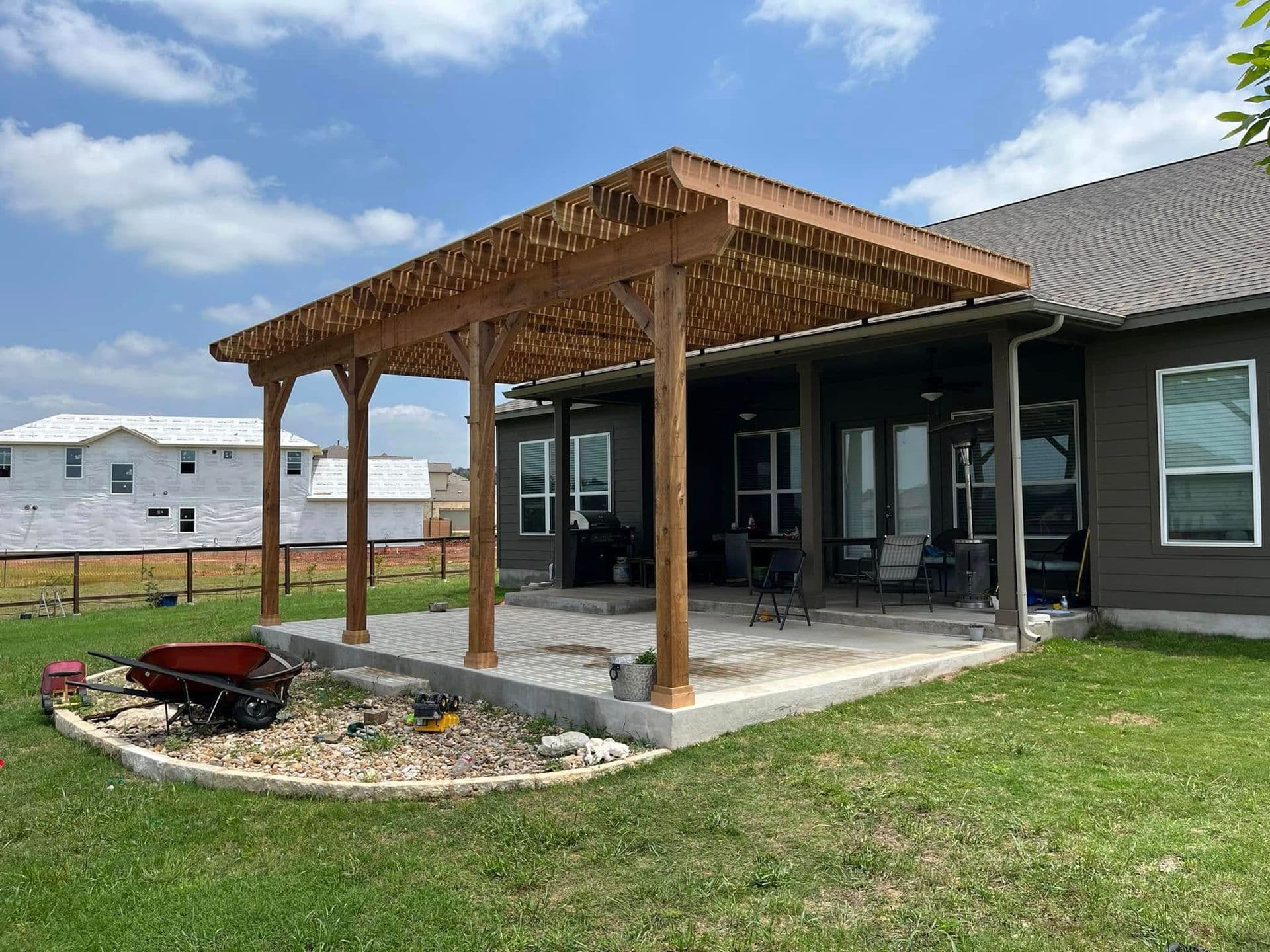
In Bee Cave, a pergola usually has to satisfy an architectural committee before it satisfies anyone else. Communities like Spanish Oaks and Falconhead set material and color standards, so we design with natural cedar, stains that suit the stone and stucco homes here, and proportions that match the house. A 12x14 cedar pergola runs $14,000 to $22,000.
Meeting Bee Cave architectural guidelines
Bee Cave HOAs typically review materials, colors, and design details, and they want drawings that show how the pergola relates to the house. We prepare elevations, stain samples, and a site plan, then submit before the city permit so any committee changes happen once. Permits are issued by the City of Bee Cave.
Scale is the common sticking point. A thin pergola looks out of place next to a large stone house. Heavier posts, deeper beams, and wider rafter tails bring it into proportion.
Rafter tail shape is another detail committees notice. A simple bevel or a curved cut repeated from the house trim ties the pergola to the architecture for very little added cost. We show the tail profile in the drawings so the committee approves exactly what gets built.
A pergola over an outdoor kitchen
Many Bee Cave backyards already have a grill island or plan one. An open pergola suits a kitchen because smoke and heat escape through the rafters. We keep the grill clear of the framing per the manufacturer's clearance, and we plan outlets and lighting before the posts go up so wiring runs inside the frame instead of along it.
Plan lighting early. Strip lighting routed along the beams or a fan hung from a center beam needs blocking and wire paths before the stain goes on. It costs less to plan than to retrofit.
Building on Bee Cave rock
Bee Cave lots sit on Hill Country limestone, often with rock right at the surface. We drill each footing into it. That gives a very stiff base, which is useful on lots with long views and wind coming up the hills. Steel post bases keep cedar off the concrete so it does not wick water.
Hillside lots add one more step. The downhill posts can be much taller than the uphill ones, and those long posts get bracing so the frame stays square. We check each footing location on its own instead of assuming the whole site is level rock.
Cedar or painted pine in Bee Cave
Western red cedar runs $45 to $65 per square foot and holds its color with a stain every two to three years. Pressure-treated pine runs $30 to $45 and works when the HOA wants a painted finish that matches trim. On a 14x20, the framing alone is 280 square feet, or $8,400 to $12,600 in pine and $12,600 to $18,200 in cedar. A complete 14x20 cedar project runs $22,000 to $35,000.
We Know Bee Cave Backyards
Bee Cave sits in the Hill Country west of Austin and is home to the Hill Country Galleria, with homes on limestone hills and many lots that slope toward a view. Several well-known communities around it, like Spanish Oaks, sit just outside city limits, so the rules for your lot depend on the exact address. We build decks, covered patios, pergolas, gazebos and outdoor kitchens in and around Bee Cave.
Permits, HOAs, soil and local building tips for Bee Cave
"Bee Cave jobs usually come down to material and detail. The homes are built with stone and heavy timber, so a thin aluminum cover looks out of place. Cedar beams or a standing seam roof match better. And on a sloped lot, we spend time on what the deck looks like from below, not just from the house."
- Peter Toomey, Founder
Why Pergolas Matter Here
Pergolas define outdoor rooms without enclosing them. They're perfect for creating an outdoor dining area, framing a view, or adding vertical interest to a flat yard. The open design allows climbing plants like wisteria or bougainvillea to create natural beauty.
Architectural Impact
A well-designed pergola elevates your entire landscape. It frames views, creates vertical interest, and adds sophistication that flat patios can't match.
Flexible Shade Options
Start with an open pergola and add shade later - retractable canopies or shade sails. Your needs may change; a pergola adapts.
Perfect for Plants
Climbing vines like wisteria, jasmine, or bougainvillea thrive on pergola structures. Create a natural, living shade canopy that blooms seasonally.
Defines Outdoor Rooms
A pergola creates a "ceiling" for your outdoor space without walls. It signals where the living area is, organizing your backyard naturally.