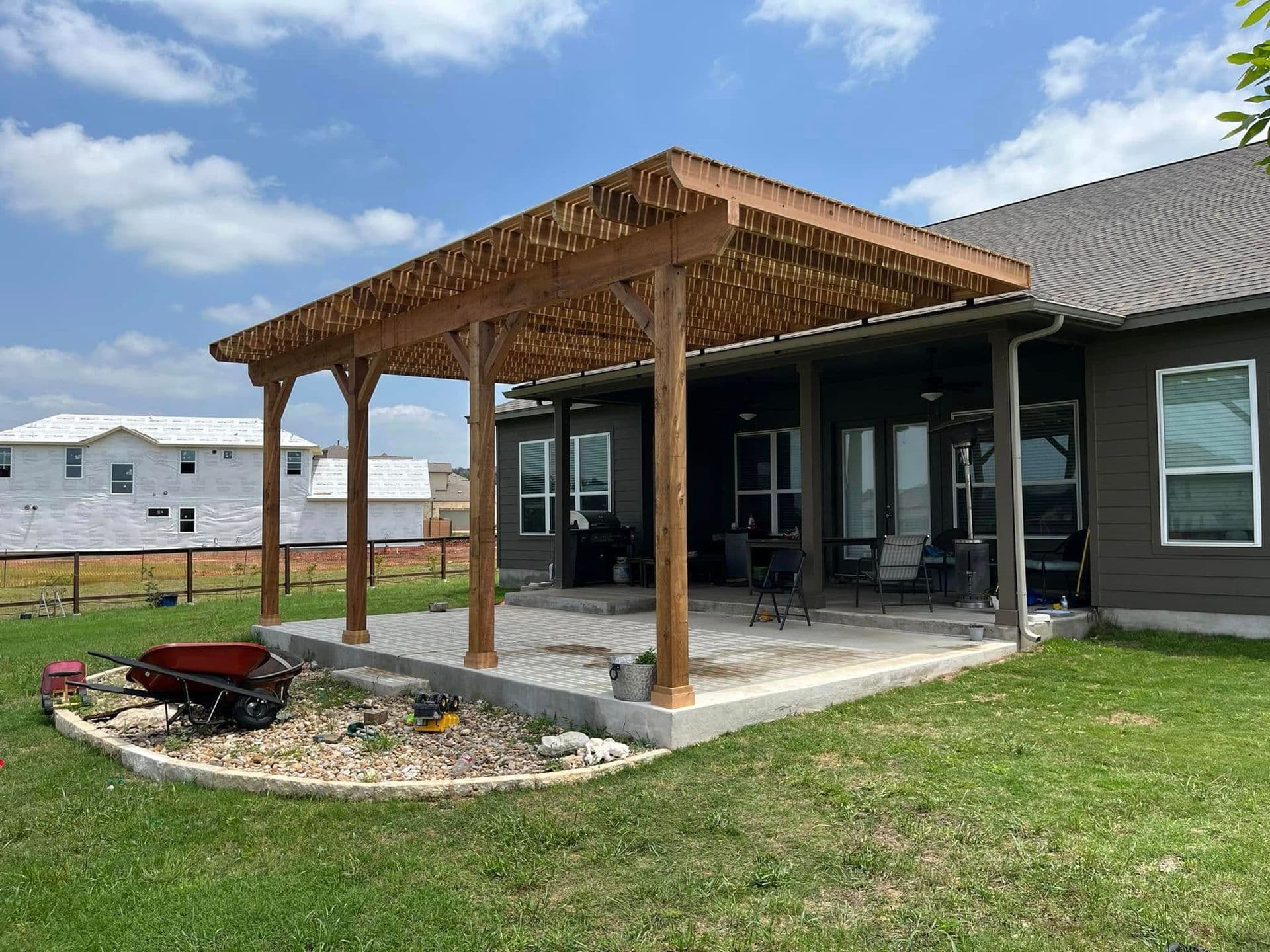
Most Hutto backyards are new, treeless, and sitting on some of the most expansive clay in the metro. A pergola here needs deep piers to stay level and more shade than a standard open frame gives, which is why many Hutto owners pair tighter rafters with a retractable canopy. An attached 10x12 runs $8,000 to $12,000.
Expansive clay under Hutto pergolas
Hutto sits on Houston Black clay, a Blackland Prairie soil that swells when wet and shrinks and cracks in drought. A post on a shallow footing moves with it and starts to lean. We set piers deep enough to reach soil that stays stable, and we grade and direct gutter water away from the post bases.
With an attached pergola, the house foundation and the pergola piers can move a little differently. We detail the wall connection so small movements do not crack brick or pull flashing.
Termites are a factor across Central Texas, so we keep wood posts off the ground on steel bases above the concrete.
Getting real shade in a new Hutto yard
Without mature trees, the pergola is the shade. A standard open frame blocks about 25 to 50 percent of the sun. Tighter rafter spacing gets you to roughly 60 to 70 percent. A retractable canopy reaches 90 percent or more and slides back in winter. If you want full shade and rain cover every day, a covered patio is the better structure, and we can price both side by side.
Rafter direction counts too. Rafters set across the path of the afternoon sun block more of it for the same amount of lumber. We check where the sun sits over your patio in the late afternoon and set the layout from that.
Pergolas over builder patios in Hutto
Builder patios in communities like Star Ranch are usually modest. We often extend the living area with pavers or a low deck and set the pergola posts outside the original slab on their own piers. That avoids cutting the builder slab and gives every post a real footing in the clay.
Hutto permits, HOAs, and price
Permits are issued by the City of Hutto, and most newer neighborhoods have HOA review for materials and setbacks. We handle both. In cedar, a 12x14 frame is 168 times $45 to $65, or about $7,600 to $10,900 before footings and finish. Complete 12x14 cedar freestanding projects run $14,000 to $22,000.
Pine or cedar both work over Hutto clay once the footings are right. Pine at $30 to $45 per square foot suits a painted pergola that matches builder trim. Cedar at $45 to $65 stays straighter as it dries and resists rot and insects on its own. Either needs fresh stain or paint every two to three years in full sun.
We Know Hutto Backyards
Hutto grew fast on open Blackland Prairie east of Round Rock, so most homes are newer, most yards get full sun, and nearly every lot sits on deep expansive clay. That makes shade and footings the two big decisions on a Hutto project. We build covered patios, decks, pergolas, gazebos and screened porches across Hutto.
Permits, HOAs, soil and local building tips for Hutto
"Hutto is prairie. No trees to speak of in a lot of the newer neighborhoods, so the sun hits the whole backyard all afternoon. That's why most people here want a roof, not just a deck. And it's black clay under there, so we go deep on footings and keep the water moving away."
- Mark Toomey
Why Pergolas Matter Here
Pergolas define outdoor rooms without enclosing them. They're perfect for creating an outdoor dining area, framing a view, or adding vertical interest to a flat yard. The open design allows climbing plants like wisteria or bougainvillea to create natural beauty.
Architectural Impact
A well-designed pergola elevates your entire landscape. It frames views, creates vertical interest, and adds sophistication that flat patios can't match.
Flexible Shade Options
Start with an open pergola and add shade later - retractable canopies or shade sails. Your needs may change; a pergola adapts.
Perfect for Plants
Climbing vines like wisteria, jasmine, or bougainvillea thrive on pergola structures. Create a natural, living shade canopy that blooms seasonally.
Defines Outdoor Rooms
A pergola creates a "ceiling" for your outdoor space without walls. It signals where the living area is, organizing your backyard naturally.